
Online media and journalists from local communities may face closure and a number of other problems if the draft amendments to the Law on Media, which are in parliamentary procedure, are passed in their current form. This is the conclusion of the panel discussion "Amendments to the Law on Media and Local Media", which was held in Skopje on March 27, 2025, organized by the Independent Trade Union of Journalists and Media Workers (SSNM) and the RESIS Institute, within the framework of the project "Workers' Rights for Independent Journalism", supported by the European Union.
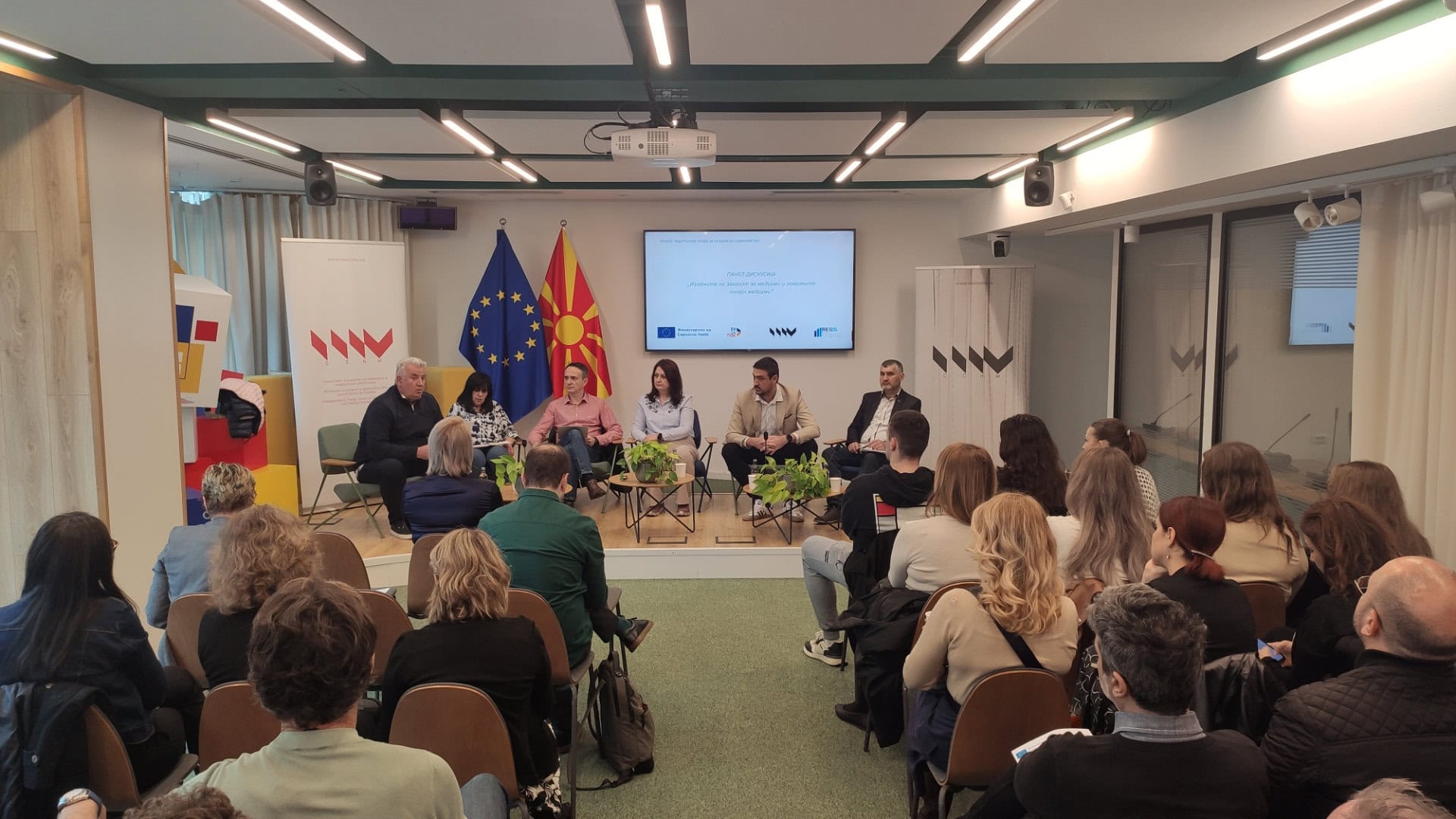
The President of the SSNM, Pavle Belovski, emphasized that there is an undoubted need for online media to be included in the law, but that a comprehensive reform of media laws that will be harmonized with European regulations – especially with the European Media Freedom Act – should urgently begin.
“We believe that it is necessary to make an amendment and reduce the criterion for local media, specialized media and community media, which, although they are small media, still create important content and publish information of public interest. What I can say now, although we have previously advocated this position, is that the register of professional media should contain only the basic criteria, such as an imprint, transparent ownership, MK domain and the like, but stricter criteria such as the number of employees, or other criteria that could be added, if there is a will for that, should apply only in the event that these media apply for any form of budget funds,” Belovski said.
He added that more than a quarter of the citizens in Macedonia live in so-called media deserts, where there is neither a local media outlet nor a correspondent, and that this seriously affects media pluralism and the democratic processes in the country.

The journalist from Bitola, Aneta Blaževska, referred to the criteria provided for in the amendments to the law that would apply to registration in the register of online media, for which the Agency for Audio and Audiovisual Media Services will be responsible.
"What you say about three employees is impossible for us. Why is it impossible? Because there is no money. We do not have socially responsible companies at the local level that operate in Bitola. They do not advertise in any media in Bitola. How would we finance ourselves? We would have to be swindlers to those in power. Another thing that scares me, and it is not only related to the requirement for three employees, which requires a lot of money,... is that if we do not register - those journalists who do investigative journalism and who are constantly sued and are in court - how will we be held accountable? As journalists? Or will we be held accountable as ordinary citizens?" said Aneta Blaževska from Apla.mk, Bitola.

Ubavka Janevska from the local Veles online media outlet Duma agreed, adding that local journalism means working full-time and continuously on news from local communities, from the region it covers.
“We look at calls in the evenings, write applications and hope that if we receive financial support it will help us maintain the media with two employees. It is not an easy job, and without additional support we will never be able to work on additional investigative stories. We are the ones who go to events in the local community and ask questions before publishing the information, and we work barely for a minimal personal income. Changes in this form could be fatal for us local media outlets,” said Janevska.

The President of AJM, Mladen Čadikovski, said that voluntary regulation is needed in a so-called voluntary register of online media, but that a clear definition of the status of media that function as civil society organizations is also needed.
“In order to avoid selective application of the law, simplified registration criteria are also needed,” Čadikovski said.
In the discussion, which was attended by a large number of journalists and representatives of professional associations and non-governmental organizations from the media sphere, it was clearly emphasized that the proposed partial legal solutions are unacceptable and harmful, especially the provision that makes registration in the register of online media conditional on the number of employments. Experiences from other countries in the region and beyond were also pointed out, where such a condition does not exist at all for entry into the register maintained by the regulatory body, but is prescribed as a condition only when applying for state funds.
The panel discussion was held within the framework of the project "Workers' Rights for Independent Journalism" implemented by the Independent Union of Journalists and Media Workers in partnership with the RESIS Institute, and supported by the European Union.


